

Movement & Exercise
Building a Weekly Movement Routine That Fits
Movement guidance is usually written for people who already exercise. This page starts from a real week and works back to what you can actually do.
Jakarta · walking, cycling, dancing and short activity breaks · a weekly routine you can keep
The benchmark, translated

Moderate intensity · talk but not sing
The activity benchmark, translated
Public health guidance commonly cited is 150 to 300 minutes of moderate-intensity activity per week, or 75 minutes of vigorous activity, plus muscle-strengthening work at least twice a week. That works out to roughly 30 minutes of moderate activity on five days.
Moderate intensity has a simple test: you can talk but not sing while doing it. Brisk walking, cycling on flat ground, and dancing all fit. You don't need a gym, and you don't need to do it all at once. Three ten-minute blocks land in the same place as one half-hour block, which matters if your day has no obvious gap in it.
- Moderate
- 150–300 min a week
- Vigorous
- 75 min a week
- Strength
- Twice a week
Walking: the easiest place to start
Walking is the most accessible movement option for most people in Indonesia. A 30-minute brisk walk covers roughly 2.5 to 3 kilometers at a comfortable pace, and you already know the route. If 30 minutes in one block is unrealistic, three 10-minute walks count the same toward your weekly total.
Before work, during lunch, after dinner — the consistency matters more than the timing. Pick the slot you are least likely to cancel, and treat that slot as fixed. Two things make a walk brisk rather than a stroll: your breathing picks up but you can still hold a conversation, and your pace is faster than a shopping-centre amble. If you can carry a full conversation without pausing, walk a little quicker.
- Route Choose a flat loop near home or the office so bad weather and traffic don't decide for you.
- Shoes Supportive, broken-in footwear matters more than any tracking device.
- Splits Three 10-minute walks across the day are a legitimate way to hit 30 minutes.

30 minutes · roughly 2.5–3 km · can be split into three short walks

Commuting and weekend rides both count
Cycling: for commuting and weekends
Cycling is listed in vascular-health guidance as an accessible aerobic activity, and it fits both commuting and leisure. In Jakarta, Surabaya, and Bandung, weekend cycling groups are common, and many neighbourhoods have quiet streets suitable for a 30-minute ride.
If you commute by motorbike or car, consider cycling for short errands instead — a trip to the warung, the pharmacy, or a nearby meeting. You get the movement without adding a separate workout slot to your day. Flat ground keeps the effort in the moderate range; hills push it higher, which is fine as long as you build up to them.
Weekend riders should keep one rule in mind: distance is not the goal, regular time on the bike is. A steady 45 minutes every Saturday beats one long ride followed by three weeks off.
Dancing
Movement that doesn't feel like exercise
Dancing is named alongside walking and cycling as a beneficial moderate activity, and it suits people who find formal workouts tedious. A 45-minute session at home, a class, or a social event all count toward the weekly total.
The advantage is sustainability. Enjoyment is what keeps a routine alive past the third week, and consistency is what moves the needle for circulation. If dancing is the activity you'll actually return to, it belongs in your week ahead of anything you dread.
A 45-minute dance session counts the same as a 45-minute brisk walk
Muscle-strengthening twice a week
The activity guidelines pair aerobic movement with muscle-strengthening work at least twice a week. This doesn't require a gym, a trainer, or equipment you have to order. Bodyweight squats, push-ups, lunges, and a resistance band cover most of what you need.
Two 20-minute sessions a week is enough to hit the benchmark. Schedule them on days you're not doing longer aerobic work, so the week doesn't pile up on one evening. Start with two sets of each movement and add a set when the last one stops feeling like work.
Strength work supports the muscles that keep you moving — legs, hips, back, and shoulders — which is what lets a walking or cycling habit survive the years rather than the month.
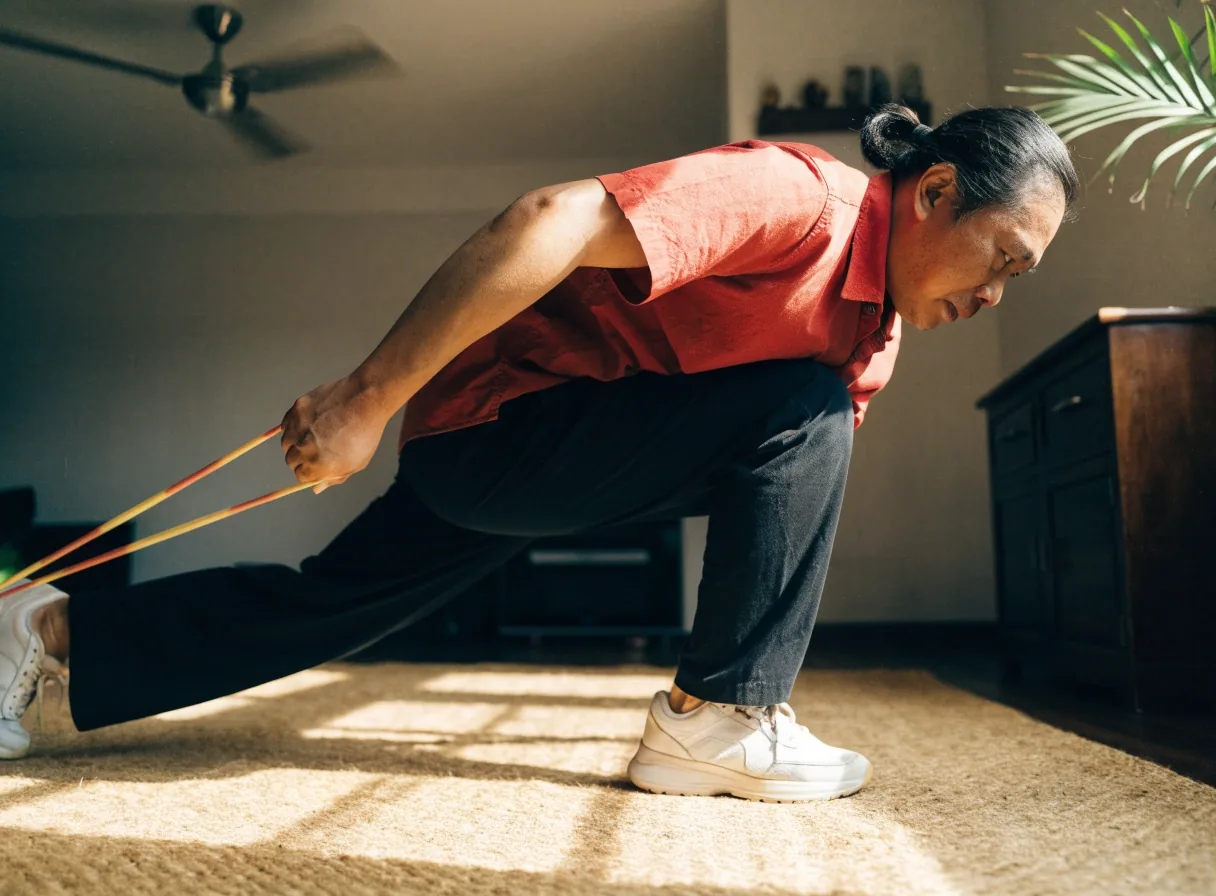
Two 20-minute sessions · squats, push-ups, lunges, resistance bands
Short activity breaks count
Small actions add up. Taking the stairs instead of the lift, parking farther from the entrance, walking to a colleague's desk instead of messaging, standing during phone calls. Vascular-health guidance explicitly encourages these small moves.
None of them replace a 30-minute walk, but they raise your baseline movement across the day, which is where most sedentary time accumulates. If you work at a desk, these breaks are the easiest minutes you'll find.




A sample week
One example, not a prescription. Adjust it to your schedule, and don't worry about perfect adherence — a week that lands close to the benchmark is a good week.
If a session gets skipped, pick up on the next day rather than trying to make it up twice over.
Monday
30-minute brisk walk, in one block or split into three short walks.
Tuesday
20-minute strength session: squats, push-ups, lunges, resistance band.
Wednesday
30-minute walk, ideally the same route and time as Monday.
Thursday
20-minute strength session, adding a set where the last one felt easy.
Friday
30-minute walk or a 45-minute dance session, whichever you'll actually do.
Saturday
Longer ride or walk, 45 to 60 minutes, at an easy conversational pace.
Sunday
Rest or light activity, such as a short evening walk.

Before you start · diagnosed heart conditions, uncontrolled blood pressure, joint problems, or years away from activity
When to check with a doctor first
If you have a diagnosed heart condition, uncontrolled blood pressure, joint problems, or you've been inactive for years, check with a healthcare professional before starting a new routine. This is standard guidance, not a reason to avoid movement altogether.
For most healthy adults, starting with walking and building gradually is safe and sensible. The useful questions to bring to that conversation are simple: how hard should I push at the start, what signs should make me stop, and how quickly can I add time? A short answer from someone who knows your history is worth more than any general plan.
Common questions about building the routine
Time Does a 10-minute walk really count the same as 30 minutes in one go?
Yes, for the weekly total. Three 10-minute brisk walks add up to the same 30 minutes of moderate activity as one continuous walk. The shorter blocks are easier to fit around work, prayer times, and family, so they often survive a busy week better than one long slot.
Weather How do I keep walking through the rainy season?
Move the walk indoors or shift the time. Covered walkways, mall corridors, and stairwells work; so does walking in the early morning before the afternoon build-up. If the rain wins for a day, a dance session or an indoor strength session keeps the week intact.
Build-up How fast should I add time if I've been inactive?
Start below the benchmark and build over a few weeks. Ten minutes most days is a reasonable first step; add five minutes when that feels comfortable rather than when the calendar says so. Muscle soreness that fades in a day or two is normal. Pain that changes how you walk is a signal to stop and ask.
Tracking Do I need a fitness tracker or a step target?
No. A watch or phone app can help some people stay consistent, but the weekly minutes matter more than the device. If tracking turns the routine into a scoreboard you resent, drop it and keep the walk.
Missed days What if I miss most of a week?
Restart at the level you left off, or one step below it. Missing days is normal; abandoning the routine because of them is the thing worth avoiding. The next walk is the whole plan.
Where to go next
Continue through the series
Movement is one habit among several that shape circulation. The pages below cover the rest, and each one fits a normal working week rather than an idealised one.
Read desk and commute tipsThe wider picture
Hydration, sleep, and avoiding tobacco all sit alongside movement in the same weekly picture. Our guide to daily habits walks through how they fit together.
See how daily habits fit togetherThe starting point
If you have not read the basics yet, start with how circulation works and what affects it day to day.